

Are you a chiropractic care professional in Australia looking to rank as highly as you deliver excellent chiropractic care? A strong local SEO strategy can help your practice become more visible when people in your service area are actively looking for chiropractic services.
There is a sizable market to compete for. The health-items/contents/allied-health-services">Australian Government data recorded 499,014 Medicare-subsidised chiropractic services in 2019 under the chronic disease management program, involving 148,073 patients. While this is not a measure of total chiropractic demand, it demonstrates that chiropractic care forms a meaningful part of Australia’s allied health landscape.
For chiropractic practices, however, visibility is only part of the equation. You need to appear for searches relevant to your location, services and patient needs, while presenting enough trustworthy information to encourage potential patients to take the next step.
In this blog, we discuss 10 proven local SEO strategies for chiropractors in Australia, from optimising your Google Business Profile and targeting local keywords to earning relevant backlinks, managing reviews and measuring performance.
Read on to learn how to attract more local patients and build sustainable growth for your chiropractic practice, with Exact Funnel’s expert SEO strategies helping you strengthen local visibility, reach high-intent audiences and turn search traffic into valuable enquiries.
How to Outrank Local Chiropractic Competitors: 10 Local SEO Tactics for Chiropractors in Australia
Local SEO is about more than adding your suburb to a few website pages. It is about helping search engines understand what your practice offers, where you operate and why your business is relevant and trustworthy for local searches.
Why Local SEO Matters for Chiropractic Practices
A potential patient might search for:
- Chiropractor near me
- Chiropractor in [suburb]
- Back pain chiropractor [location]
- Sports chiropractor [location]
- Chiropractic care near me
- Chiropractor open today
- Best chiropractor in [city]
These are commercially valuable searches because the person is often already considering a healthcare provider.
A well-executed local SEO strategy can help your practice:
- Get found when people are actively searching for chiropractic care
- Attract people who are more likely to enquire or book
- Build credibility before a prospective patient contacts you
- Create a more sustainable acquisition channel than relying entirely on paid advertising
- Strengthen your position as a recognised local practice
But how does it work?
It starts with the foundation of local search visibility: your Google Business Profile.
Let’s take a closer look.
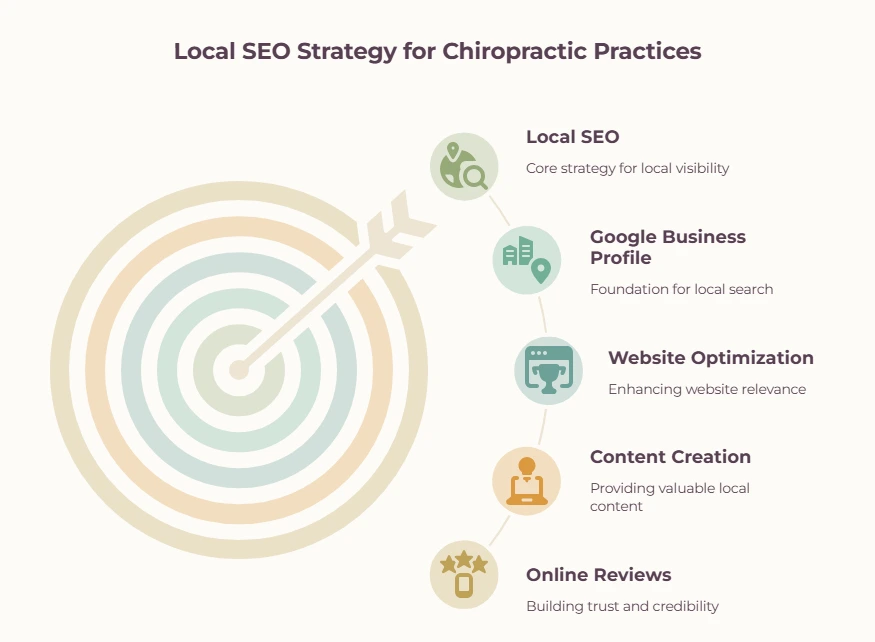
1. Optimise Your Google Business Profile for Maximum Local Visibility
Your Google Business Profile (GBP) is one of the most important assets in a local SEO strategy for chiropractors.
When someone performs a local search, Google considers factors including relevance, distance and prominence when determining which local results to display. Google also states that complete and accurate Business Profile information can help businesses appear for relevant local searches.
Start by making sure your profile accurately reflects your real-world practice.
Your chiropractic practice should have:
- The correct business name
- Accurate address and contact information
- Correct opening hours
- An appropriate primary category
- Relevant additional categories where genuinely applicable
- A clear business description
- Current photographs of the practice
- Relevant services
- Accurate booking or appointment information
- Regularly maintained profile information
Do not attempt to manipulate your business name by stuffing keywords or locations into it. Google requires businesses to use their real-world business name and warns that unnecessary information in the business name can result in problems, including suspension.
Your profile should also accurately represent the business. If you have multiple practitioners or locations, the setup needs to follow Google’s specific Business Profile guidelines rather than creating duplicate or misleading profiles.
Think of your GBP as your local search storefront. It should give someone enough information to understand your practice and decide whether it is worth taking the next step.
2. Target Local Keywords and Build Hyperlocal Content
Ranking for “chiropractor” nationally is neither realistic nor necessarily useful for a local practice.
Your objective should be to capture searches that have genuine relevance to the areas and services you serve.
Start with your primary location:
Chiropractor in [Suburb]
Then expand into related search themes such as:
- Chiropractor [Suburb]
- Chiropractor near [Suburb]
- Chiropractic clinic [City]
- Sports chiropractor [Location]
- Back pain chiropractor [Location]
- Chiropractic treatment [Location]
- Chiropractor near [Neighbouring Suburb]
The key is search intent.
Do not create dozens of almost identical suburb pages simply by replacing the location name. Thin, repetitive location pages provide little value to users and can create a poor overall website experience.
Instead, create genuinely useful local pages where there is a legitimate business reason to serve that area.
For example, a chiropractic practice in Melbourne could develop a strong location page explaining its services, accessibility, practitioner expertise, appointment process and relevance to patients in the surrounding community.
You can also build hyperlocal content around questions your prospective patients actually ask.
Topics might include:
“What Should I Expect From My First Chiropractic Appointment in [Location]?”
or
“How Often Should You See a Chiropractor? A Guide for [Location] Patients”
The location should support the content rather than being inserted artificially.
3. Build Local Citations and Earn Relevant Backlinks
Local SEO does not stop at your website and Google Business Profile.
Google considers information from across the web when assessing the prominence and relevance of businesses. Google specifically notes that prominence can be influenced by information such as links, articles and directories, alongside reviews and other signals.
This makes citations and backlinks valuable components of a chiropractic SEO strategy.
A citation is a mention of your business’s key details, such as its:
- Name
- Address
- Phone number
- Website
The information should be accurate and consistent across legitimate business directories and relevant industry platforms.
For Australian chiropractic practices, citation opportunities may include appropriate:
- Australian business directories
- Local business directories
- Professional or industry organisations
- Local community websites
- Health-related directories
- Chamber or business association websites
But quantity should not be the objective.
A directory link from a reputable, relevant website can be more valuable than submitting your practice to hundreds of low-quality directories.
📖 People also read about:
Backlinks can also be earned through legitimate digital PR and content activity.
For example, your practice could contribute expert commentary to a relevant publication, collaborate with complementary local businesses or publish genuinely useful resources that other websites want to reference.
The goal is to build real authority, not manufacture links.
4. Generate and Manage Online Reviews That Build Trust
For a healthcare practice, trust matters.
A prospective patient may compare several chiropractic practices before deciding where to make an appointment. Reviews can provide useful third-party evidence about the patient experience and can also contribute to local search visibility. Google states that review count and positive ratings can influence local ranking.
The right approach is to make review generation part of your normal patient experience.
You can politely ask genuine patients to leave feedback after an appointment or appropriate stage of their care journey. Google allows businesses to ask customers for reviews using a review link or QR code.
However, healthcare businesses need to be particularly careful about how reviews are requested and used.
Do not:
- Pay patients for reviews
- Offer discounts in exchange for reviews
- Ask only happy patients to leave reviews
- Ask patients to change or remove negative reviews in exchange for an incentive
- Manufacture or post fake reviews
- Tell patients what specific rating or wording to use
Google explicitly prohibits incentivised and manipulated reviews.
You should also respond professionally to reviews while protecting patient privacy. Do not disclose or confirm private health information in a public response.
For Australian businesses, review-related marketing also needs to comply with broader consumer law requirements. The ACCC states that online reviews should be independent and genuine and that business claims must be truthful and based on reasonable grounds.
5. Use Localised Content Marketing to Strengthen Authority
A chiropractic website should do more than list services. It should answer the questions prospective patients are asking before they book.
This is where content marketing becomes an important part of local SEO.
Create content around topics that align with your actual expertise and services, such as:
- What happens during a chiropractic consultation?
- When should you see a chiropractor for back pain?
- What should you wear to a chiropractic appointment?
- Chiropractor vs physiotherapist: what's the difference?
- How can chiropractic care support mobility?
- What questions should you ask your chiropractor?
- What should you know before your first appointment?
You can then localise appropriate content naturally. For example:
“Choosing a Chiropractor in Sydney: What Should You Look For?”
is more commercially relevant to a Sydney practice than a generic article about chiropractic care. However, healthcare content requires an additional layer of responsibility.
Chiropractic practices should avoid exaggerated promises, unsupported health claims or language implying guaranteed outcomes. Chiropractors are regulated health practitioners in Australia, and the Australian Bureau of Statistics classifies chiropractic as a regulated occupation requiring registration or licensing.
All chiropractors must be registered with Ahpra, according to Healthdirect.
📖 People also read about:
Your content should therefore demonstrate genuine expertise while keeping claims accurate, appropriately qualified and consistent with applicable advertising requirements.
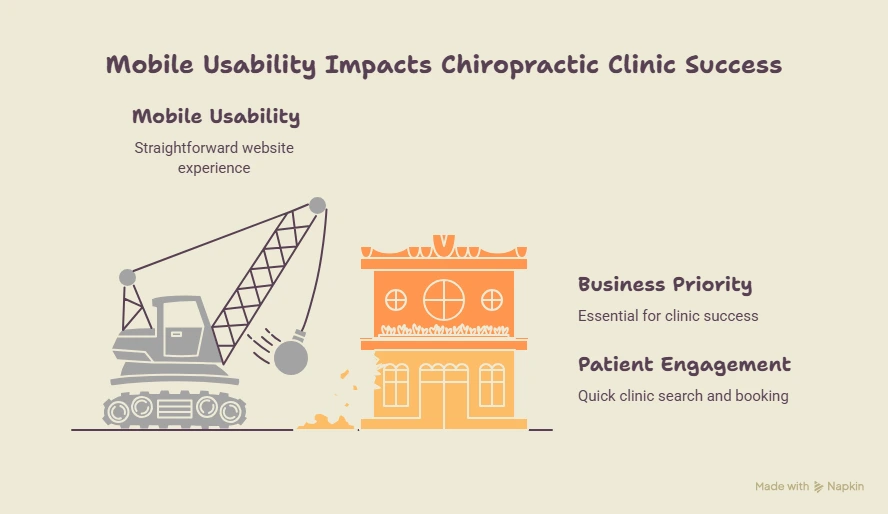
6. Optimise Your Website for Mobile and Conversational Searches
Local patients are not necessarily searching from a desktop.
Someone experiencing discomfort may search for a nearby chiropractic clinic from their phone, check opening hours, look at reviews and call or book an appointment within minutes.
That makes mobile usability a business priority. Your website should provide a straightforward experience across mobile devices, including:
- Fast-loading pages
- Easy-to-read text
- Clear navigation
- Prominent contact details
- Simple appointment pathways
- Click-to-call functionality where appropriate
- Easy-to-use enquiry forms
- Accessible location information
- Clear service information
You should also consider conversational search behaviour.
Instead of typing: “chiropractor Sydney”, one can search: “Where can I find a chiropractor near me that’s open on Saturday?”
Or “What does a chiropractor do for lower back pain?”
Build content that naturally answers these longer, conversational queries. Avoid writing awkward content specifically for “voice search”. Instead, structure useful information around the questions your prospective patients actually ask.
7. Implement Relevant Schema Markup for Better Search Understanding
Schema markup, also called structured data, helps search engines understand the information contained on your website.
For a chiropractic practice, structured data can help communicate information about the business, such as its name, location and other relevant details. Depending on your website and business setup, appropriate structured data may include relevant Local Business information and other applicable schema types.
The important word here is appropriate!
Do not add schema simply because a particular markup type sounds useful. The structured data should accurately represent the visible information and follow Google’s requirements.
💡 Need help?
We offer professional local seo services for hvac to help you achieve your goals.
Schema markup also does not guarantee that Google will display a particular rich result. Its primary value is helping search engines interpret your content more effectively.
For a local practice, structured data should work alongside, not replace, strong website content, accurate business information, technical SEO and a well-maintained Google Business Profile.
8. Use Social Media to Strengthen Local Engagement
Social media is not a replacement for local SEO, and simply posting on Instagram or Facebook does not automatically improve your Google rankings.
However, social platforms can support your wider local marketing strategy. Use your social presence to showcase the real people and expertise behind your practice.
For example, you could share:
- Educational content
- Practitioner introductions
- Practice updates
- Community involvement
- Relevant health information
- New services
- Behind-the-scenes content
- Educational videos
- Answers to common patient questions
Where appropriate, participate in local community conversations and collaborations. The objective is not to stuff every post with keywords. It is to create a recognisable local brand that people encounter across multiple touchpoints.
This complements your SEO, content marketing and reputation-building efforts.
Remember that healthcare marketing needs to remain accurate and responsible across social media as well. The ACCC notes that consumer law requirements apply to claims made through social media, websites, testimonials and other business communications.
9. Track Local SEO Performance and Turn Data Into Decisions
Can one improve what one does not measure?
A local SEO campaign should be evaluated using business-relevant metrics rather than simply asking, “What position do we rank at?”
Track indicators such as:
- Organic search traffic
- Local search visibility
- Google Business Profile interactions
- Website enquiries
- Phone calls
- Appointment requests
- Organic conversions
- Rankings for priority local keywords
- Local landing page performance
- Review growth and sentiment
- Backlink growth
- Engagement with key service pages
Google Business Profile performance data can help you understand how customers discover and interact with your listing. The important part is connecting SEO activity with business outcomes.
For example, ranking in position one for a low-intent keyword may be less valuable than ranking well for “chiropractor [suburb]” and generating qualified appointment enquiries.
Review your data regularly and adjust your strategy accordingly.
10. Partner With a Professional SEO Agency for Chiropractic Growth
Local SEO can look straightforward from the outside.
In practice, sustainable results require research, technical optimisation, content development, local authority building, reputation management and ongoing analysis.
This is particularly important for chiropractic practices because your SEO strategy operates within a regulated healthcare environment. Your website needs to attract search traffic without relying on exaggerated claims or potentially misleading marketing language.
This is where working with an experienced SEO agency can make a difference.
At Exact Funnel, we can help chiropractic practices build a local SEO strategy around the way prospective patients actually search.
Our approach can include:
- Local SEO audits: We identify technical, on-page and local visibility issues affecting your website and Google Business Profile.
- Keyword research: We identify location-based and service-focused search opportunities that align with your practice.
- On-page optimisation: We optimise important service, location and supporting content so search engines and users can understand your offering.
- Local content strategy: We develop useful, location-relevant content designed around genuine search intent.
- Citation and authority building: We identify relevant opportunities to strengthen your local presence across credible websites and directories.
- Google Business Profile optimisation: We help ensure your profile is complete, accurate and aligned with Google’s guidelines.
- Performance tracking: We monitor organic visibility and conversion-focused metrics to understand what is generating meaningful results.
Most importantly, SEO should not operate as an isolated marketing activity. It should support your broader patient acquisition strategy.

Strengthen Your Local Search Presence and Grow Your Chiropractic Practice
Ranking locally is not about finding one secret SEO trick. It is about consistently sending the right signals across your Google Business Profile, website, content, reviews, citations, backlinks and broader online presence.
Google itself identifies relevance, distance and prominence as key factors in local results. For chiropractic practices, that means building a digital presence that clearly communicates three things:
- What you offer.
- Where you offer it.
- Why prospective patients should trust your practice.
Get those foundations right, continue producing genuinely useful content, maintain your local reputation and measure what actually drives enquiries.
And if managing all of this alongside running a busy chiropractic practice feels like a full-time job, professional SEO support can help you build a more structured and sustainable approach.
Ready to make your chiropractic practice more visible in local search? Exact Funnel can help you develop an SEO strategy designed around your location, services and growth objectives.