
If you run a small or medium-sized business in Singapore, having a strong online presence is no longer just a marketing advantage, it is essential for staying visible, competitive and accessible to your target customers. It is increasingly part of how customers discover, compare and choose businesses. Singapore has more than 300,000 enterprises, with SMEs making up over 99% of them, making the local search landscape highly competitive.
At the same time, digital adoption among Singapore SMEs continues to grow. According to IMDA’s Singapore Digital Economy Report 2025, 95.1% of SMEs had adopted at least one measured digital area in 2024, up from 94.5% in 2023.
That means simply having a website is no longer enough. Your business needs to be discoverable when potential customers search for the products, services and solutions you provide.
Exact Funnel helps Singapore businesses build search strategies that connect visibility with measurable business growth.
What Is Local SEO and Why Does It Matter for SMEs?
Local SEO is the process of improving your business’s visibility in search results for geographically relevant searches. For example, your customer might search:
- accountant in Singapore
- digital marketing agency near me
- best dentist in Tampines
- office renovation company Singapore
- Italian restaurant in Tiong Bahru
- IT support for small business Singapore
These searches are different from broad informational searches because they often have a local or commercial intent. The person is looking for a business, service or solution that they can potentially contact or purchase.
Local SEO helps search engines understand key information about your business, including what you offer, where you operate and how your business relates to a particular search.
For SMEs, this can create an important acquisition channel. Instead of relying entirely on paid advertising or outbound sales, your website and local online presence can continue attracting people who are already searching for what you sell.
And local SEO is not limited to Google Maps. A strong strategy can encompass your:
- Google Business Profile
- Website
- Service and location pages
- Local content
- Online reviews
- Business directories and citations
- Relevant backlinks
- Structured data
- Technical SEO
- Conversion pathways
The objective is not simply to rank higher. It is to become more visible to the right people in the right locations at the right stage of their buying journey.
10 Practical SEO Strategies Every Singapore Business Should Follow in 2026
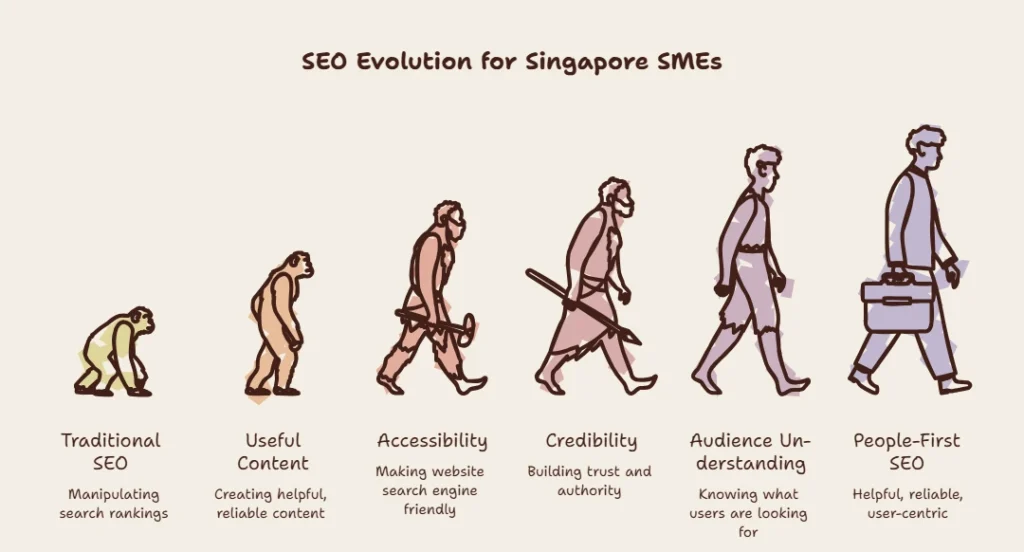
SEO has changed significantly over the years, but the fundamentals remain surprisingly consistent: create useful content, make your website accessible to search engines and users, establish credibility, and understand what your audience is actually looking for.
Google’s current guidance continues to emphasise helpful, reliable, people-first content rather than content created primarily to manipulate search rankings.
Here are 10 practical strategies Singapore SMEs should prioritise in 2026.
1. Create Helpful Content That Solves Real Customer Problems
One of the biggest mistakes businesses make is creating content simply because they want to rank for a keyword. Instead, start with the customer.
What questions do prospective customers ask before contacting you? What problems are they trying to solve? What information do they need before making a purchase?
For example, an accounting firm could create content around: What Does a Small Business Need to Prepare for Corporate Tax Filing in Singapore?
A commercial renovation company could answer: How Much Does an Office Renovation Cost in Singapore?
An IT company could address: What Should a Singapore SME Look for in a Managed IT Services Provider?
The best content does more than mention a keyword repeatedly. It provides useful information, demonstrates genuine knowledge and helps the reader make a better decision. Google’s guidance specifically recommends creating original, substantial and satisfying content that provides value beyond what is already available elsewhere.
For SMEs, this creates another advantage: your subject-matter expertise can become a competitive asset.
2. Demonstrate Experience, Expertise, Authority and Trust
E-E-A-T stands for Experience, Expertise, Authoritativeness and Trustworthiness.
It is important to clarify that Google does not describe E-E-A-T as a single ranking factor. Rather, Google’s quality systems use signals associated with these concepts to help identify useful and trustworthy content. Google also gives greater weight to strong E-E-A-T for topics that can significantly affect people’s health, safety or financial stability.
For businesses, demonstrating E-E-A-T means giving users reasons to trust you. That could include:
- Clear information about your business
- Practitioner, consultant or expert profiles
- Author bylines where appropriate
- Relevant qualifications and experience
- Original insights
- Case studies
- Demonstrable results
- Testimonials where appropriate
- Accurate contact and company information
- References to credible sources
- A detailed About Us page
Do not simply claim that your company is Singapore’s leading or best provider. Show people why they should believe you.
For B2B businesses especially, detailed case studies can be extremely valuable because prospective clients want to understand not just what you sell, but whether you have experience solving problems like theirs.
3. Make Your Website Work Smoothly on Mobile
Your prospective customer may find your business while commuting, between meetings, at home or while comparing suppliers on their phone.
A website that looks good on a desktop but is difficult to use on mobile can quickly lose that visitor. Google’s current page-experience guidance recommends ensuring that content displays well across devices, alongside considerations such as Core Web Vitals, security, intrusive interstitials and overall usability.
Check whether your website:
- Loads and displays correctly on different screen sizes
- Uses readable text
- Has buttons large enough to tap
- Provides straightforward navigation
- Makes contact information easy to find
- Keeps important content accessible on mobile
- Uses forms that are easy to complete
- Avoids intrusive pop-ups
- Provides the same essential content on mobile and desktop
Google uses mobile-first indexing, so the mobile version of your site needs to contain the content and structured data you want Google to understand and index.
4. Improve Site Speed and the Overall User Experience
Getting someone to your website is only half the job. You also need to give them a reason to stay. Slow pages, broken links, confusing navigation, excessive pop-ups and difficult-to-use forms can all create unnecessary friction.
Start with the technical fundamentals. Compress unnecessarily large images, review third-party scripts, improve server performance, remove obsolete website components and make sure important pages load efficiently.
Core Web Vitals can provide useful technical indicators around loading performance, responsiveness and visual stability. However, do not treat a perfect technical score as the entire SEO strategy.
Google explicitly recommends thinking about overall page experience, rather than focusing on one or two isolated metrics.
Ask a more useful business question: can a prospective customer quickly find what they need and take the next step? If the answer is no, there is a UX problem worth fixing.
5. Strengthen Your Local SEO Presence Across Singapore
For businesses serving specific locations, local optimisation should be a core part of the SEO strategy. Start with your Google Business Profile if you are eligible for one, ensuring your business information is accurate and consistently maintained.
Then build local relevance across your website. Depending on your business model, this may include:
- Location-specific service pages
- Singapore-focused service content
- Relevant neighbourhood or district information
- Consistent business details
- Legitimate local citations
- Relevant local backlinks
- Genuine customer reviews
- Location-specific FAQs
Avoid creating dozens of near-identical pages with only the location name changed. A page titled Plumber in Singapore should actually provide useful information for someone looking for plumbing services in Singapore. A page titled Plumber in Jurong should have a legitimate reason to exist if the company genuinely serves Jurong.
Local SEO should reflect your real-world service area, not an artificial attempt to generate hundreds of location pages.
6. Use Social Media to Expand Visibility and Brand Recognition
Social media and SEO are not interchangeable. Posting on LinkedIn, Instagram, Facebook or another platform does not automatically make your website rank higher in Google.
But social media can support your broader digital marketing strategy by helping more people discover and recognise your brand.
For B2B SMEs, LinkedIn can be particularly useful for:
- Sharing industry insights
- Publishing original research
- Promoting case studies
- Demonstrating company expertise
- Highlighting team expertise
- Sharing company announcements
- Distributing useful website content
For B2C businesses, platforms such as Instagram, TikTok or Facebook may play a larger role depending on the audience and industry.
The objective is to create multiple touchpoints between your business and your prospective customers. Someone may discover your brand on social media, later search your company name, visit your website and eventually become a customer. That entire journey matters.
7. Use Structured Data to Help Search Engines Understand Your Website
Search engines need to interpret what your pages are about. Structured data provides machine-readable information that can help search engines understand certain types of content and can make eligible pages suitable for specific search features.
For example, depending on your business and page type, relevant structured data could describe:
- Your organisation
- Local business information
- Products
- Services
- Breadcrumbs
- Events
- Articles
- Videos
However, structured data should never be treated as a shortcut to rankings. Google recommends ensuring that structured data accurately represents the visible content on the page and follows its guidelines.
Incorrect or misleading markup can create problems rather than opportunities. Before implementing schema, identify which structured data types genuinely apply to the page and validate the implementation.
8. Expand Your Content Beyond Blog Articles
Text remains important, but customers consume information in different ways. Depending on your industry and audience, consider creating:
- Short videos
- Demonstrations
- Case studies
- Original research
- Infographics
- Checklists
- Guides
- Webinars
- Podcasts
- FAQs
- Comparison pages
- Downloadable resources
This can also help you communicate expertise more effectively. For example, an engineering company could publish a technical guide alongside a short explanatory video.
A professional services firm could turn a detailed case study into a downloadable PDF and several LinkedIn posts. A B2B software company could create an implementation guide, product demonstration and customer case study around the same topic.
The key is not to create more content simply for the sake of volume. Repurpose valuable knowledge into formats that genuinely suit your audience.
9. Capture Visitor Information and Build an Audience You Own
SEO can bring prospective customers to your website, but not every visitor will be ready to buy immediately. That makes lead capture important.
Depending on your business model, you could offer:
- A consultation
- Product enquiry
- Quote request
- Newsletter
- Industry report
- Downloadable guide
- Webinar registration
- Email updates
- Product demonstration
The exact conversion mechanism should match the buying journey. A visitor researching a complex B2B service may not be ready to buy immediately. They may be more comfortable downloading a guide or requesting a consultation.
The broader principle is simple: do not let valuable website traffic disappear without an opportunity to continue the relationship. Your SEO strategy should therefore connect acquisition with conversion and lead nurturing.
10. Measure SEO by Revenue and Leads, Not Rankings Alone
Rankings are useful diagnostic metrics, but they are not the final business objective. A company can rank first for a keyword that generates very little commercial value.
Another business might rank third or fifth for several high-intent searches and generate significantly more qualified enquiries.
That is why SMEs should connect SEO reporting with metrics such as:
- Organic leads
- Qualified leads
- Enquiry rate
- Sales opportunities
- Revenue from organic traffic
- Customer acquisition cost
- Conversion rate
- High-value landing page performance
- Non-brand organic traffic
- Local search visibility
- Assisted conversions
Google’s own guidance for AI search also recommends considering business outcomes such as sales, signups and other meaningful conversions rather than focusing solely on search visibility.
Your SEO dashboard should ultimately help answer: is SEO helping the business grow? That is far more valuable than simply knowing whether a keyword moved three positions.
The Strategic Value of SEO for Small Businesses
For a small business, SEO can become a valuable long-term acquisition asset.
Paid advertising can generate visibility while a campaign is running, but SEO focuses on building an organic presence that can continue attracting relevant searchers over time.
That does not mean SEO is free traffic. Professional SEO requires investment in strategy, content, technical work, digital PR, tools and ongoing optimisation.
Its strategic value comes from building an asset that becomes increasingly useful as your website develops authority, content depth, brand recognition and organic visibility.
There is also a broader digitalisation opportunity in Singapore. IMDA reported that 95.1% of SMEs had adopted at least one measured digital area in 2024, while 97% had adopted at least one sector-specific digital solution.
As more businesses become digitally mature, having a basic website will not necessarily differentiate an SME. The businesses that stand out will be those that make their digital presence genuinely useful to customers.
That means better content, better user experience, better local visibility, better conversion pathways and better measurement.
What Has Changed in the Era of AI?
One of the biggest changes in search is the growing role of AI-generated search experiences.
Google now provides AI experiences such as AI Overviews and AI Mode, and in 2026 Google has published dedicated guidance for website owners looking to understand visibility in generative AI features.
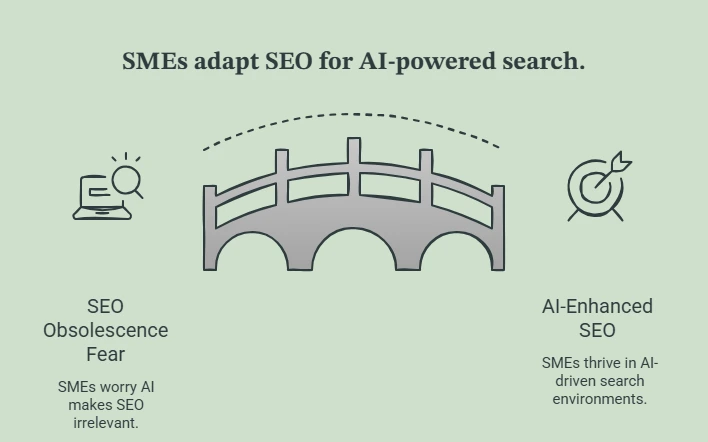
But there is an important misconception to avoid: AI search has not made SEO obsolete.
Google’s current documentation explicitly states that SEO best practices remain relevant because its generative AI search experiences are grounded in its core Search systems and index.
What has changed is the way people may discover information. Searchers can ask longer, more specific questions and continue with follow-up questions. Google’s guidance recommends focusing on unique, valuable and non-commodity content, while ensuring your website remains crawlable and provides a strong page experience. Our AI SEO team works with businesses on exactly this shift.
This creates several priorities for SMEs.
Create Original Information
Generic content is easier to replicate. Original research, first-hand experience, proprietary insights, expert commentary and genuine case studies are harder to replace.
Answer Specific Questions
Instead of targeting only broad keywords, build useful content around the questions your customers actually ask.
Strengthen Your Brand
When someone searches for your company by name or encounters your content repeatedly across different channels, brand recognition can influence whether they choose you.
Make Your Content Easy to Understand
Clear headings, concise answers, supporting detail and logical page structures help both people and search systems understand your content.
Keep Your Website Crawlable
Google’s AI search documentation emphasises that generative AI features use publicly accessible, crawlable content from its Search index.
AI has therefore changed the search experience, but the fundamentals of creating a technically sound, authoritative and useful website remain highly relevant.
Build a Stronger Local SEO Strategy With Exact Funnel
SEO in 2026 requires more than publishing a few blog posts and adding keywords to your homepage.
For Singapore SMEs, the opportunity lies in building a search strategy that connects technical SEO, local visibility, helpful content, authority, user experience and measurable conversions.
At Exact Funnel, we help businesses develop SEO strategies around the actual commercial objectives. Our approach includes:
- Technical SEO audits and optimisation
- Keyword and search-intent research
- Local SEO and Google Business Profile optimisation
- Service and location page optimisation
- Content strategy and content creation
- On-page SEO
- Structured data implementation
- Conversion-focused website optimisation
- Authority and link-building strategies
- SEO performance reporting
- Organic lead and revenue tracking
We do not believe SEO should be reduced to a monthly ranking report. The real question is whether your search presence is helping you reach the right audience, generate qualified opportunities and grow the business.
If your Singapore SME is ready to build a more strategic organic search presence, talk to our team at Exact Funnel and we will help turn SEO into a measurable part of your growth strategy.