

If you run a psychology practice in Australia, your website needs to do more than tell people where you are and what services you offer. It needs to help the right people find your practice, understand what you offer and feel confident taking the next step.
The Australian psychology market is also substantial and competitive. Psychology Board of Australia data has previously reported more than 35,000 psychologists holding some form of registration in Australia, with the profession continuing to grow. The Board reported that registrations were increasing consistently, with approximately 700 to 1,000 psychologists entering the workforce each year.
For individual psychologists, group practices and multi-location clinics, that makes search visibility increasingly important. Someone looking for support may search for a psychologist in their suburb, a particular area of psychological care, or answers to questions they have before deciding whether to make an appointment. SEO helps your practice become visible across that journey.
At Exact Funnel, we help businesses build SEO strategies around visibility, qualified traffic and measurable commercial outcomes.
What Does SEO for Psychologists Actually Involve?
SEO, or search engine optimisation, is the process of improving a website and its wider online presence so search engines can better understand, index and surface it for relevant searches.
For a psychology practice, those searches can look very different depending on what someone needs. A prospective client might search:
- psychologist near me
- psychologist Sydney
- psychologist Melbourne
- psychologist Brisbane
- psychologist Perth
- psychologist for anxiety
- psychologist for depression
- child psychologist Sydney
- psychologist for ADHD assessment
- couples psychologist Melbourne
- trauma psychologist Brisbane
- online psychologist Australia
- psychologist accepting new clients
These searches indicate different levels of intent. Someone searching “what does a psychologist do?” may still be researching. Someone searching “psychologist for anxiety near me” may be actively considering professional support.
Someone searching for the name of a specific psychology practice is already familiar with the brand. A strong SEO strategy should account for these different journeys rather than treating every search as an opportunity to sell an appointment.
For psychologists, SEO therefore involves much more than adding keywords to a homepage. It can include:
- Search-intent research
- Google Business Profile optimisation
- Local SEO
- Service-page strategy
- Location-page optimisation
- Helpful educational content
- Practitioner and author information
- Technical SEO
- Internal linking
- Structured data
- Online reputation and local visibility
- Conversion optimisation
- Search performance measurement
- Healthcare advertising compliance
The objective is not simply to rank for “psychologist”. The objective is to build a search presence that helps relevant people find accurate information, understand your practice and take an appropriate next step.
Why Local SEO Is Particularly Important for Psychology Practices
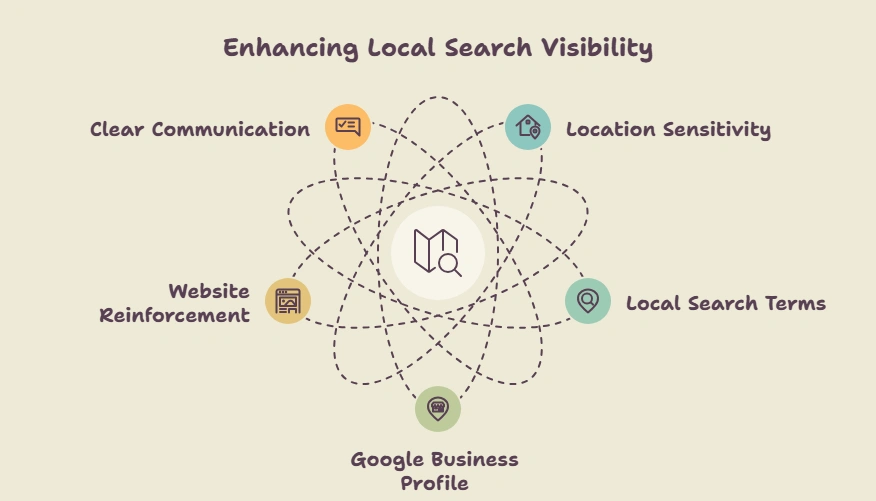
Psychological services are often location-sensitive. Even when telehealth is available, many people still want to find a psychologist who practises close to home, work or another convenient location.
That creates significant value in local searches such as psychologist in Parramatta, psychologist near me, psychologist Melbourne CBD, child psychologist Brisbane, psychologist North Sydney, and so on.
Local SEO helps search engines associate your practice with its genuine location, services and service area.
For eligible practices, your Google Business Profile is an important part of that local presence. Business information should be accurate, consistent and representative of the real-world practice.
Your website should reinforce that information rather than contradict it. For example, if your practice has a physical clinic in a particular suburb, your website should clearly communicate:
- The practice name
- Physical location
- Contact information
- Opening hours where relevant
- Services available
- Practitioner information
- Appointment options
- Accessibility information where useful
- Areas genuinely served
Local SEO isn’t about inserting a suburb into every sentence. It is about giving search engines and prospective clients a clear understanding of who you are, what you provide and where you provide it.
Building a Psychology Website Around Search Intent
One of the biggest SEO opportunities for psychology practices is improving website structure.
Many practices have a homepage, an “About” page, a generic “Services” page and a handful of blog articles. That can make it difficult for both users and search engines to understand the breadth of services offered.
A stronger structure starts with the actual services and areas of practice. For example, depending on what the practice genuinely provides, the website architecture could include a main Psychology Services page, supported by pages for:
- Individual psychology
- Child and adolescent psychology
- Couples psychology
- Workplace psychology
- Psychological assessments
- Telehealth psychology
Then, where clinically and commercially appropriate, individual service pages can provide more detail.
This gives each important service a clear destination. It also allows the content to answer the questions a prospective client may have before contacting the practice.
Don't create pages simply because a keyword exists
Suppose a practice sees an opportunity for:
- psychologist for anxiety
- psychologist for depression
- psychologist for stress
- psychologist for trauma
- psychologist for relationship problems
That doesn’t automatically mean you need five near-identical pages. Does each page have a legitimate purpose?
If separate pages are created, they should provide genuinely different and useful information rather than changing a few keywords and reproducing the same template.
Google’s current guidance explicitly encourages substantial, original, people-first content rather than content produced primarily to capture search traffic.
For psychology websites, this matters even more because generic or poorly reviewed content can undermine trust.
E-E-A-T Matters Even More for Psychology Websites
Psychology falls within a category where the quality and trustworthiness of information can have a meaningful effect on people’s health and wellbeing.
Google describes these as YMYL topics and says its systems give greater weight to strong E-E-A-T for topics that can significantly affect people’s health, financial stability or safety. Google also makes an important distinction: E-E-A-T itself is not a single ranking factor. Instead, its systems use a mix of signals associated with experience, expertise, authoritativeness and trustworthiness.
For a psychology website, this means demonstrating credibility isn’t optional window dressing.
It should be built into the website.
Make the People Behind the Practice Visible
A prospective client should be able to understand who is providing the service. Your practitioner profiles can include factual information such as:
- Name
- Professional role
- Qualifications
- Areas of practice
- Relevant professional experience
- Languages spoken, where appropriate
- Registration information where appropriate
- Professional memberships where relevant
Information about qualifications and experience should be accurate and presented without implying credentials or expertise that the practitioner does not hold.
Ahpra states that information about a practitioner’s title, qualifications, specialty, training and areas of experience must be factual. It also provides specific guidance around the use of titles and claims about registration, competence and qualifications.
Add Authorship to Educational Content
If your practice publishes articles about mental health, psychological assessment or other sensitive topics, it should be clear who created or reviewed the material where appropriate.
Google specifically recommends making it clear who created content and providing background about authors where readers would reasonably expect it.
For a psychology practice, an article written or clinically reviewed by an appropriately qualified professional is much stronger from a trust perspective than an anonymous article produced purely for SEO.
Creating Content That Prospective Clients Actually Need
Should a psychology-based blog exist simply because someone said that “Google likes fresh content”?
Google explicitly states that it does not reward content simply because it is produced to a particular word count or because a website keeps publishing content for the sake of seeming fresh. It recommends content created primarily to help people, with original information, substantial coverage and clear expertise.
For psychologists, content can be valuable when it answers questions people genuinely have. Depending on the practice, useful topics might include:
- What happens during a first psychology appointment?
- How do I know if I should speak to a psychologist?
- What is the difference between a psychologist and a psychiatrist?
- What should I expect from psychological assessment?
- How does telehealth psychology work?
- How can parents support a child who is struggling at school?
- What questions should I ask when choosing a psychologist?
- What is involved in an ADHD assessment?
- When might someone seek support for anxiety?
- How can workplace stress affect wellbeing?
The exact topics should be based on the practice’s services, expertise and audience rather than a generic keyword list.
Avoid Turning Educational Content Into Diagnosis
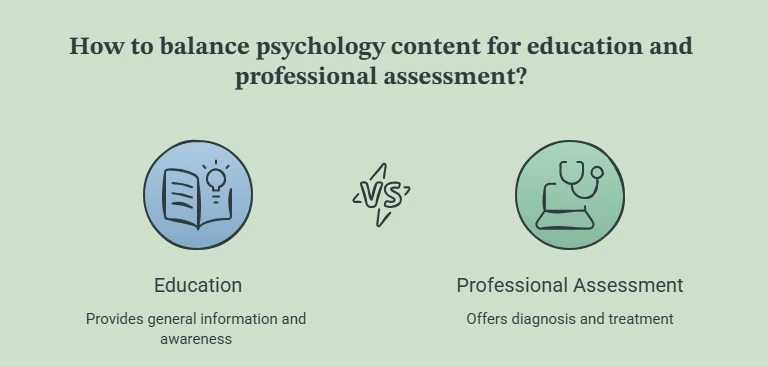
Psychology content requires particular care. A page discussing symptoms or mental health conditions should not encourage readers to diagnose themselves based solely on a checklist.
The content should provide useful general information while making the distinction between education and professional assessment clear.
This is both a quality issue and a trust issue. A good article should leave a reader better informed, not convinced that an online checklist has diagnosed them.
Psychology SEO and Australian Healthcare Advertising Rules
This is one of the most important differences between SEO for psychologists and SEO for a standard commercial business.
Psychology is a regulated health profession in Australia, and advertising a regulated health service is subject to the Health Practitioner Regulation National Law and Ahpra’s advertising guidance.
Ahpra explains that advertising includes public communications that promote and seek to attract people to a regulated health service, including electronic communications. It also makes clear that businesses and third-party marketing agencies can fall within the advertising framework.
Avoid Misleading Claims
Ahpra’s advertising guidance prohibits advertising that creates or is likely to create unwarranted or unrealistic expectations about the effectiveness of regulated health services. It also addresses claims that treatments are infallible, guaranteed or certain cures.
So phrases such as:
- "Guaranteed results"
- "The best psychologist in Australia"
- "We can cure anxiety"
- "Get rid of depression permanently"
- "The fastest psychological treatment"
- "Guaranteed recovery"
can create significant compliance concerns depending on their context and substantiation. SEO copy should never sacrifice accuracy for a keyword or conversion goal.
Be Careful With Comparative Claims
Claims suggesting that one psychologist, practice or regulated service is better than another can also raise compliance issues.
Ahpra’s guidance addresses comparative advertising and misleading comparisons involving health services and practitioners.
That means a safer approach is to explain what your practice offers rather than making unsupported claims about why you are “better” than competing psychologists.
Patient Testimonials and Psychology SEO: A Critical Distinction
Reviews and testimonials deserve particular attention. Under Section 133(1)(c) of the National Law, advertising a regulated health service using testimonials or purported testimonials about the service or business is prohibited.
Ahpra explains that testimonials can include positive statements about clinical aspects such as symptoms, diagnoses, treatment, outcomes or the practitioner’s clinical skills. It also distinguishes these from certain non-clinical comments, such as comments about customer service or communication that don’t refer to clinical aspects.
This creates an important distinction: A patient independently posting a review on a review platform is not the same thing as a practice using that review to advertise its regulated health service.
A psychology practice should therefore not simply collect positive Google reviews and copy the clinical ones onto its website as marketing testimonials.
This is an area where an SEO agency needs to understand the client’s regulatory environment rather than applying a generic “add testimonials for trust” template.
Optimising Practitioner Pages for Search and Trust
Practitioner pages can play a valuable role in both SEO and conversion. A good psychologist profile should answer the questions a prospective client is likely to have, and the content should remain factual.
If a practitioner has a postgraduate qualification, relevant experience or recognised registration/endorsement, that information can be communicated accurately.
Do not use vague phrases such as “leading expert” or “Australia’s top psychologist” unless there is a legitimate and supportable basis for the claim.
Ahpra’s guidance specifically notes that qualifications and experience can be advertised when presented accurately and factually.
Technical SEO: The Foundation Behind the Content
A practice can have excellent educational content and still struggle in search if its website has technical problems.
A technical SEO review should consider:
Crawlability
Can search engines access your important pages?
Indexation
Are your key service, practitioner and location pages actually eligible to appear in search?
Internal Linking
Are related pages connected logically?
For example: Psychology → Anxiety → Anxiety Psychology Services → Relevant Practitioner
Page Speed and Usability
Does the website work smoothly across devices?
Mobile Experience
Can someone quickly find the information they need on a phone?
HTTPS and Security
Is the site securely delivered?
Canonicalisation
Are search engines being given clear signals when similar or duplicate URLs exist?
Broken Links and Redirects
Do important pages lead users where they are supposed to?
XML Sitemap
Are your important URLs discoverable through a properly maintained sitemap?
Technical SEO isn’t about making a website “look good to Google”. It is about removing barriers that prevent search engines from understanding and users from successfully navigating the site.
Structured Data for Psychology Websites
Structured data can help search engines understand certain information about a page. Depending on the website and content, appropriate markup may communicate information about:
- Organisation
- Local business details
- Breadcrumbs
- Articles
- Events
- Other eligible content types
However, schema should be treated as a supporting technical layer rather than an SEO shortcut.
Google’s current guidance for AI search also states that there is no special AI schema or additional structured-data requirement needed to appear in AI Overviews or AI Mode.
Existing SEO fundamentals remain important, including crawlability, internal links, textual content, page experience and keeping structured data consistent with visible page content. For a psychology practice, the principle is straightforward:
Use structured data where it accurately represents the page, not simply because a plugin allows you to add it.
Local SEO Beyond Google Business Profile
Google Business Profile is important, but local SEO doesn’t stop there. Your website should reinforce your local relevance through genuine information about your practice.
This might include:
- Location pages for genuine practice locations
- Accurate address information
- Consistent business details
- Relevant local references
- Local partnerships
- Professional organisation profiles
- Appropriate local citations
- Relevant links from reputable local or industry websites
Don’t create dozens of suburb pages simply because you want to rank in every suburb. For example, if a psychology practice operates in one Melbourne suburb but claims to serve every suburb across Victoria through near-identical landing pages, those pages may provide little value.
A better approach is to clearly explain the actual location and service area and create genuinely useful local content where there is a legitimate reason for it to exist.
Building Authority Through Relevant Links and Mentions
Links remain part of the wider search ecosystem, but link-building for a psychology practice should be particularly careful.
Don’t buy hundreds of low-quality links or submit the practice to irrelevant directories simply because they offer a “high DA backlink”.
Instead, build legitimate authority through the practice’s actual professional ecosystem. Potential opportunities may include:
- Psychology organisations
- Professional publications
- Educational institutions
- Community organisations
- Local initiatives
- Relevant industry publications
- Research contributions
- Professional events
- Expert commentary
- Genuine partnerships
The strongest authority signals are often connected to things the practice genuinely does outside its website.
If a psychologist contributes expert commentary to a reputable publication, participates in professional education or produces original resources, those activities can support a broader digital footprint.
What Does AI Search Mean for Psychologists in 2026?
Google’s search experience continues to evolve, with AI Overviews and AI Mode allowing people to ask longer, more conversational and more complex questions.
The important point for psychology practices is that AI search has not replaced SEO.
Google’s current documentation states that the same foundational SEO practices remain relevant to AI features. There are no special technical requirements or separate “AI SEO” markup required to appear as a supporting link in AI Overviews or AI Mode.
Google’s newer guidance also emphasises unique, valuable, non-commodity content and recommends focusing on genuine expertise and original perspectives rather than trying to exploit artificial “AEO” or “GEO” hacks.
For psychologists, this is particularly relevant.
Consider the difference between: “What is anxiety?”, and “How can I choose a psychologist for anxiety in Australia, and what should I expect from the first appointment?”
The second question requires more context.
It may involve location, practitioner expertise, service format, appointment expectations and other considerations.
A practice that creates genuinely useful resources around these questions has more opportunity to demonstrate expertise than one publishing hundreds of short, generic keyword pages.
Build Content That Contains Something That Needs Citing
AI systems can summarise information that already exists everywhere. Your opportunity is to provide something more useful. That might include:
- Original practitioner insights
- Expert commentary
- Clear explanations
- Practice-specific resources
- Original research or analysis
- First-hand observations
- Detailed FAQs
- Well-structured service information
Google’s AI-search guidance specifically recommends unique, valuable content rather than commodity information that could easily be reproduced elsewhere.
SEO for Psychology Practices Should Connect Search With Conversion
More traffic isn’t automatically more business. A psychology website can receive thousands of organic visits and still generate relatively few enquiries if visitors cannot work out what to do next.
Your SEO strategy should therefore consider the conversion journey. A prospective client should be able to move naturally from: Search → Relevant page → Trust → Understanding → Next step
That next step could be:
- Book an appointment
- Contact the practice
- Request an appointment
- Call the clinic
- Complete an enquiry form
- Learn more about a practitioner
- Understand available appointment options
The exact conversion depends on how the practice operates.
Don’t force every visitor into “Book Now”. Someone reading an educational article may need more information before they are ready to contact a psychologist.
That is why effective SEO and conversion optimisation need to work together.
Measuring SEO Success for a Psychology Practice
Keyword rankings are useful, but they aren’t the complete picture. A better SEO measurement framework can include:
Visibility
- Organic impressions
- Search visibility
- Local search presence
- Non-branded search growth
Engagement
- Organic sessions
- Landing-page engagement
- Returning visitors
- Key content performance
Leads
- Appointment enquiries
- Phone calls
- Contact forms
- Booking interactions
Commercial Outcomes
- Qualified enquiries
- New-client acquisition
- Appointment bookings
- Revenue attributable to organic search where reliable tracking is available
Local Performance
- Google Business Profile interactions
- Calls
- Website visits
- Direction requests where applicable
How Exact Funnel Approaches SEO for Psychologists

SEO for psychology practices requires a different level of care from standard local-business SEO.
At Exact Funnel, we don’t approach a psychology website by simply selecting a list of keywords and producing pages around them. We look at the whole search and conversion ecosystem.
We Start With Search Intent
Our team identifies what prospective clients are actually searching for and separate informational, service-specific, practitioner-related and local intent.
This helps determine which pages should exist and what each page needs to accomplish.
We Build the Website Around Genuine Services
Your core services should have clear, useful destinations rather than being buried inside a generic services page.
We optimise those pages around search intent while keeping the information accurate and appropriate for a healthcare audience.
We Strengthen Local Visibility
For practices with physical locations, we work on the local signals that help connect the practice with its genuine service area.
This can include Google Business Profile optimisation, location-page strategy, local relevance and appropriate authority-building activities.
We Develop Expert-Led Content
Instead of producing content simply to hit a monthly publishing target, we focus on questions that prospective clients actually need answered.
Where appropriate, content can be developed around practitioner expertise and reviewed to ensure the information accurately reflects the practice.
We Address Technical SEO
We identify issues involving crawling, indexing, internal links, site architecture, page experience, structured data and other technical foundations.
We Connect SEO With Conversion
A successful SEO campaign should not stop when someone lands on the website. We assess whether visitors can understand the service, find the right information and take the appropriate next step.
We Measure Business Outcomes
Our focus is not on producing reports filled with keyword movements that have no connection to the business.
We aim to connect search visibility with traffic, enquiries and measurable growth wherever tracking allows.
If your psychology practice is ready to build a more strategic organic search presence, Exact Funnel helps you connect SEO with qualified visibility, enquiries and sustainable growth.
Have more questions about SEO? Contact us today to discuss how a strategic SEO approach can support your practice’s growth.